FutureBank: A New Blueprint for Digital-First Banking — Rethinking What a Bank Can Be

The banking world is transforming rapidly, and at the heart of this transformation lies one undeniable truth: the future of banking is digital-first, customer-centric, and experience-driven.

In “FutureBank: A New Blueprint for Digital-First Banking”, we explore what the next generation of banking could look like—and what it should look like. This is not just a vision for modern banking; it’s a practical roadmap for how institutions can evolve, innovate, and lead.

What Makes FutureBank Different?

Rather than following the trends, FutureBank redefines them. From intelligent onboarding flows that complete registration in seconds, to AI-powered checkout agents that optimize eCommerce experiences, every chapter showcases real use cases and scalable features banks can adopt to remain competitive.

It’s a journey into:

  • 🌐 Omnichannel banking where customer journeys are uninterrupted across devices.
  • 🧠 AI and machine learning that do more than chat—they predict, recommend, and protect.
  • 💼 Embedded finance that empowers partners, fintechs, and corporates to co-create.
  • 🧺 Smart eCommerce tools like basket sharing and group gifting that enhance shopping experiences.
  • 🔐 Layered security and data sharing models that ensure trust while supporting open ecosystems.

Why This Book Matters Now

In an age where customer expectations are shaped by seamless digital experiences across industries, financial institutions can no longer afford to move slowly. FutureBank serves as both a wake-up call and a how-to guide. It’s written for banking professionals, tech leaders, fintech disruptors, and anyone passionate about reshaping the way money moves and serves people.

“A future bank isn’t the one that adopts every new technology. It’s the one that chooses the right technology—and uses it to create real value.” — FutureBank

Ready to Rethink Your Bank’s Future?

Whether you’re building the next neobank, leading digital transformation in a legacy institution, or just curious about what the next five years of banking innovation will bring, this book is your starting point.

👉 Grab your copy of FutureBank: A New Blueprint for Digital-First Banking and join the movement toward smarter, faster, more human banking.

Download it now

Super App Strategy – Full book

In conclusion, this document on Super App applications is the result of a collaborative effort of combined expertise. It is important to note that there are multiple design approaches to Super Apps that cannot be fully encapsulated in a book, and that this document is not the optimal solution.

Rather, it is an attempt to provide an overview and shed light on what we have found to be important in the journey of building such applications. We hope that this book has provided valuable insights and guidance for those interested in the development of Super Apps, and that it will inspire further exploration and innovation in this rapidly growing field.

07-Market place

Throughout the previous modules and components, our goal was to pave the way for a successful ecosystem market place. In essence, the market place was the end goal that we were building towards through all our previous efforts. The market place is the primary customer-facing product that will attract users to our ecosystem and encourage them to try out our services. A well-designed and convenient market place can lead to a loyal customer base, which can be the engine for fast market entry and penetration, resulting in increased transactions and revenue.

By prioritizing a user-friendly and engaging market place, we can create a loyal user base that drives activity, transactions, and ultimately revenue. The market place represents the culmination of all our previous efforts, and is the most important link between our ecosystem and our end-users.

A successful market place is crucial for the overall success of our ecosystem, as it provides a platform for users to engage with our services and generate revenue. By leveraging all our previous modules and components, we can create a convenient and engaging market place that attracts a loyal customer base and drives growth.

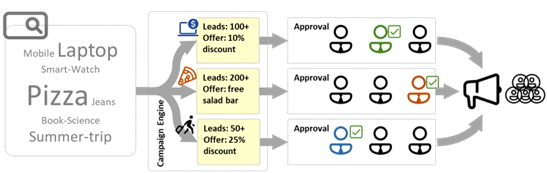
With the addition of machine learning and AI technologies to our ecosystem, we can build a platform that understands customer behavior and changes in habits. By conducting comprehensive history analysis, we can provide a personalized view along with customized advertising and offers dynamically generated for each user. The smart components included in the platform will work together to maximize transactions and customer interaction, leveraging the following key features:

  • Dynamic offering: Building on customer usage and navigation preferences, the system will run dynamic offers for matched customer segments.
  • Scheduler leads: This approach generates leads via the scheduler module based on the user’s listed events.
  • Smart bundling: Depending on the product, the system will bundle each order with smart-fit services or products that actually meet the customer’s needs.

Scheduler leads

Generating leads from scheduled events is a key strategy for upselling matched products in our ecosystem. The system should match a set calendar event with a relevant product list or features to propose a personalized offer and push the best deal to close the sale. For example:

  • Birthday events can trigger offers for gift-related products such as a memorable souvenir or a birthday cake. The smart ecosystem can also extend this by offering travel deals if the historical data reveals the customer’s interest in travel or adventure.
  • Scheduled meetings can also be used to generate leads for discounted formal attire or a new pair of shoes, especially if the event keywords reveal an interview or graduation ceremony.
  • Another example for leads generated from a schedule is offering drive-sharing trips or hotel accommodations in addition to flight ticket reminders for added travel convenience.

In addition to generating leads from scheduled events, the ecosystem can also auto-generate calendar events for relevant products based on successfully completed orders. For example:

  • After using the ecosystem to book a travel ticket, the system can predict multiple possible leads that usually follow this type of order, such as:
    • Accommodation deals that come with special offerings within the arrival dates as stated in the booked travel ticket.
    • Touristic location deals and gift shop offers.
    • Transportation deals, and more.
  • Another practical example of leveraging completed orders comes with the grocery option. The system can use the collected customer information and usage habits to decide the proper date to show cleaning product offers again for the customer. This addresses one of the main gaps in the current digital space where users are bombarded with ads even after the sales order is completed.

Dynamic offering

A traditional dynamic offering system uses historical data and combines it with browsing and search keywords to push offers to customers. Additionally, the ecosystem groups common customer searches and shares data with registered merchants and business accounts, even suggesting a smart offering to be published immediately if approved by the vendor.

This approach runs in a blind bidding mode for all merchants, allowing the system to acquire the best value for customers while also providing a sufficient conversion rate for the merchants. By leveraging historical data and customer search behavior, the ecosystem can provide personalized and targeted offers to customers, increasing the likelihood of a sale. Additionally, by sharing data with registered merchants and business accounts, the ecosystem can create a competitive bidding environment, resulting in the best possible deals for customers.

Overall, this approach provides a win-win situation for both customers and merchants, as the ecosystem can maximize revenue while providing the best value for customers. By continually refining and improving the dynamic offering system, the ecosystem can create a sustainable and profitable platform for all stakeholders involved.

Smart bundling

A sophisticated bundling algorithm generates unique product combinations that can be tailored to a specific situation or based on additional voluntary user information. This allows the ecosystem to link a product with an ongoing purchase, enhancing the customer’s overall shopping experience.

For instance, if a customer is about to purchase a washing machine, the system will automatically suggest a bundled deal with a laundry detergent product at a discounted rate. Moreover, the smart ecosystem will analyze the buyer’s profile to offer an additional option, such as installation services, at a reduced price.

Additionally, if the product requires delivery to a high-rise building and a furniture lift is not available, the system will offer a bundle that includes two carrier staff to deliver the item to the doorstep. The system will continuously generate new bundles and adjust discounts or add new items depending on the customer’s response, increasing the likelihood of a sale.

With such a smart bundling algorithm, the ecosystem can offer a vast range of products with personalized touches for each order, catering to the unique needs of each customer. This can drive engagement and result in increased revenue for the ecosystem.

06-Channels

In a super-app ecosystem, channels refer to all available portals and interfaces that are published for customers, partners, and internal teams to access the ecosystem’s functionalities. This includes applications and interfaces that are designed for customers, as well as web portals that are available for partners and business entities to manage their business with additional tools compared to the customer version.

While mobile applications are typically the most popular and convenient channel for customers, internal teams such as system admins, finance teams, fraud experts, and monitoring and auditing teams also require their own internal management interface to maintain the system and monitor the overall activities. External partners should also have their own published interface that gives them the tools to report, configure and manage stocks, and fulfill orders.

A successful ecosystem leverages all available channels and touchpoints with the consumer base, starting with trendy digital channels like mobile apps and online portals, and extending to applicable integrations with social media platforms. The system should also include legacy interfaces like USSD and IVR to widen the spectrum of access for all potential customers, ensuring a convenient and seamless user experience.

05-Reconcilation

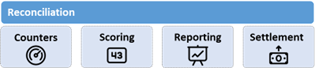
The reconciliation module is responsible for maintaining the integrity of the financial data by comparing the data in the super-app system reports against the data in parallel system reports. This process helps identify any discrepancies between the two sets of data and allows the system to reconcile any gaps.

Counters

The transaction counters module, on the other hand, is responsible for managing all applicable counters in the system. These counters can be related to accounts, products, promotions, or services and are updated and recorded by the module to prevent conflicting updates that can occur if updates are executed from different sources. The module should handle counters for successful transactions by increasing the counter and adjusting the counter for failed, rejected, or reversed requests.

Scoring

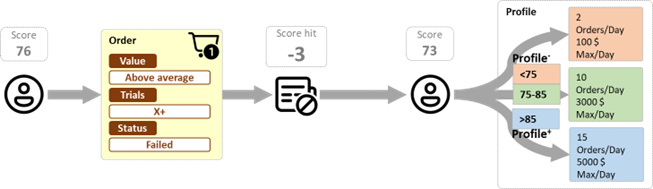
Credit scoring is a term commonly used to describe the statistical analysis conducted by financial institutions and lenders to evaluate the creditworthiness of individuals or small, owner-operated businesses. By leveraging credit scoring, lenders can make informed decisions on whether to extend or deny credit.

In the context of your visionary ecosystem, credit scoring plays a crucial role in determining credit limits for accounts through financing partners. Additionally, the ecosystem leverages the score by linking it to the profile module, allowing for dynamic handling of account upgrades or downgrades -Profile+ and Profile limits- based on changes to the rating or score.

This dynamic handling is a key part of the ecosystem’s internal system fraud prevention rules, which are designed to ensure strong security and fraud controls. This is particularly important given that the super-app ecosystem processes millions of transactions on a daily basis. By blocking fraudulent activities, the ecosystem maintains the trust of connected customers and businesses, further bolstering the system’s credibility.

It is important to note that credit scoring and fraud prevention are just two aspects of maintaining a reliable and secure financial system. Other factors that should be prioritized include data privacy, regulatory compliance, and robust cybersecurity measures. By prioritizing all of these factors, our ecosystem will continue to provide a secure and trustworthy platform for financial transactions.

Reporting and settlement

In a super-app ecosystem, reporting and settlement modules play a major role in ensuring transparency and accuracy in financial transactions. The reporting module generates detailed reports on transaction history, allowing users to track their financial activity and identify any discrepancies. These reports may include information such as transaction amounts, dates, and account balances. Additionally, the reporting module may provide analytics and insights on user behavior and spending patterns, allowing businesses to make data-driven decisions and improve their offerings.

Meanwhile, the settlement module is responsible for processing and reconciling transactions between different parties, such as merchants and customers. The module ensures that all transactions are settled accurately and in a timely manner. Settlement may involve transferring funds between accounts, reconciling payment data, and verifying the authenticity of transactions. By automating settlement processes and providing real-time updates, the settlement module helps reduce the risk of errors and delays, improving the overall efficiency of the ecosystem.

04-Service

To maintain a dynamic design, a service module is built to complement the account concept, thinking about service as the same way we trade on a daily basis. Paying at a POS machine moves funds from our card account to the merchant’s linked bank account, while paying money to friends involves cash flowing from our pocket to theirs.

Service

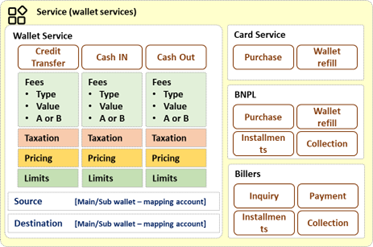
Service contains all products with the same integration endpoints, including source, destination, and inquiry interfaces if they exist. This design minimizes costs and efforts when it comes to technical upgrades or service migration in addition it lowers the impacted products while developing new features or even fixing a technical bug.

Product

Product is inherited from a service and has its parameters, which give each product its characteristics.

Service VS product

With the card service example shown in the diagram, the service debits the customer’s provided card account and credits the system wallet account, either in a wallet refill action or purchase request. This is counted as the generic definition of the card service. Coming to the illustrated products example, the purchase is configured independently from the refill activity, allowing the following:

  • Flexibility to set different limits for daily and monthly usage for each product
  • Charge each product with a unique pricing scheme
  • Calculate taxation for each product separately

Source & destination

The fund or transaction source defines the service source account to be used in this type of request. The source could be the internal system main or sub-wallet, the mapped bank, card, BNPL, loyalty, or financing account. The same goes for the destination account, which is the second transaction leg.

Fees

Product fees define the charges applied to these product orders. They might be applied on A, B, or both parties simultaneously. Additionally, fees are calculated as fixed, percentage, tiered, or slabs, to cater for the most known charging techniques.

Limits

Similar to previously explained account limits, daily and monthly counters and accumulated usage control exists per product.

Tax

Finally, a taxation module is added to allow an additional charge for all taxation applied to users directly. Worth highlighting that it’s recommended that all taxes paid by the ecosystem provider should be calculated separately within a taxation specialized system.

Transaction module

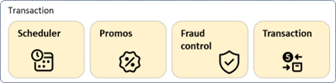
By using a unified module to execute all transactions, the payment process is streamlined and every single transaction is ensured to go through the necessary calculations, charging, controls, and reward checks if applicable.

Scheduler

In addition, the payment application features a scheduler that enables customers to set up recurring payments, which is a common scenario for those who have regular bills or payments. This allows customers to automate their payments, saving them time and effort. Customers have the option to manually initiate transactions or pre-approve recurring payments for added convenience.

Moreover, the application provides customers with the ability to set a transaction capping limit. This feature allows bills that fall below the defined capping value to be executed directly. Bills that exceed the capping value require additional approval from the customer, giving them greater control over their finances. By providing this level of flexibility, the payment application empowers customers to manage their payments in a way that works best for them.

Promotions

For all developed use cases the ecosystem should have the option run set of defined promotions to reward selected transactions parties, the reward or promotion itself will vary according t the marketing agenda and may have some of the below common rewarding scheme,

To incentivize users to make transactions within the ecosystem, the payment application should have the capability to run a set of defined promotions. These promotions can be tailored to fit the marketing agenda and can offer various types of rewards or incentives to selected transaction parties. Common rewarding schemes include,

  • Waiving or discounting fees.
  • Offering cash back or other incentive rewards.
  • Providing discounts on partner services or products.
  • Distributing discount vouchers.
  • There may also be other applicable rewarding options, depending on the specific needs of the ecosystem.

By offering these rewards and incentives, the payment application can encourage users to engage more frequently and actively within the ecosystem. This can not only increase customer satisfaction but also help to drive revenue growth for the ecosystem’s partners and stakeholders.

Fraud control

Operating a super-app ecosystem comes with inherent fraud risks, and it is essential to have robust self-defense algorithms and techniques in place to prevent potential fraudulent transactions. While fraud checks are typically handled by separate systems that can perform deep network and behavioral auditing, having real-time defensive tools can help capture trends in increasing fraudulent activity or repetitive patterns across registered accounts.

By implementing real-time defensive tools, the payment application can quickly identify potentially fraudulent activity and take action to prevent further harm. This may include blocking specific services or raising an alert flag that brings the attention of fraud experts to manually check and validate the case for possible fraud attacks.

The ecosystem’s self-defense algorithms and techniques should be continuously updated and improved to stay ahead of emerging fraud trends and techniques. By investing in robust fraud prevention measures, the ecosystem can build trust and confidence with its users and partners, while minimizing financial losses and reputational damage associated with fraud.

Transaction

The transaction module is a critical component of any e-commerce platform, as it oversees the order execution process from start to finish. It begins by applying the service logic to the order, ensuring that all requirements are met and the customer’s needs are fully addressed. Following this, the module calculates the fees and taxes associated with the transaction, taking into account any applicable regulations and guidelines.

To ensure that customers receive the best possible value for their purchase, the transaction module also checks for any promotions or discounts that may apply. This helps to build customer loyalty and satisfaction, which is essential for the long-term success of any e-commerce platform.

Finally, the transaction is subjected to a robust fraud monitoring tool to identify any potential fraudulent activity. This step is critical to maintaining the security and integrity of the platform, as well as protecting the interests of both customers and merchants.


03-Account

Building a super-app ecosystem begins with how system accounts are defined. While traditional customer and merchant account types are great, they do not reflect the true meaning of an integrated ecosystem. Therefore, it’s essential to change the account definition from rigid definitions to an adaptable model that emulates real-life scenarios. As humans, we have different skill sets and preferences, and the account model should be built to absorb multiple criteria and definitions the same way we deal with each other on daily bases.

As shown in the sample diagram, a system account is a group of tiny modules used to define and differentiate each account configured on the system.

Groups

A group is a logical container that holds system accounts and is used for reporting or applying bulk settings to multiple accounts in one click.

Groups could be used to activate, lock or block linked accounts, or to define internal system interactions where the system may force Group A not to transact with Group B. This approach allows for more flexibility and customization while configuring accounts based on various criteria such as user preferences, business needs, and transaction types.

Overall, the account model is a crucial component when building a super-app ecosystem, and a flexible and adaptable approach will enable a more seamless and personalized experience for users. The use of groups also provides more control and customization options for businesses, enabling them to manage their accounts more efficiently and effectively.

Account

The system account can be used to access system services, sell goods and services, or for an employee who is administering the system. All accounts have the same internal modules, but the values and allowed access may differ. This flexible design can easily accommodate users who want to use the system wallet for personal or business purposes, as well as actual administrators of the system.

Additionally, any defined account can own their own marketplace to sell products or services, trade credits with other accounts, family, and friends, and use their credits to purchase items from others without the need to create multiple accounts or different access on the system.

This approach enables users to have more control over their accounts and the ability to seamlessly transition between personal and professional use. It also provides a new level of flexibility for businesses to create customized account settings for their employees, giving them access to the tools and services they need to be most efficient.

Information module

Information module of the system includes essential account information, historical data, lists, and preferences for each user as outlined below:

  • Main info: This module holds account main information such as full name, address, contact details, or self-ID number. For business accounts, this module holds company name, commercial register number, and taxation ID.
  • Credentials: This module is isolated for security purposes and stores user access tokens, passwords, PIN numbers, and session IDs.
  • Lists: Lists are customizable lists created by the account holder to group family, friends, or colleagues for individuals. While for corporate accounts, lists may be used to group employees or partners accounts.
  • Schedule: This date-based module is used to save system-generated payment or installment due dates, user-added birthday events, or friendly group saving -ROSCA- payments. Users can also plan personal commitments such as rents, utility bills, or friendly transfers. Corporate accounts will use the same module to schedule payroll disbursements or collection records if applicable.
  • Score card: This module is the scorecard, which displays the output of the scoring module for each registered account. The score generation technique will be explained in the scoring module part, but it’s worth mentioning that this score impacts the user limits and allowed services on the system.

Profile

Profiles are a type of logical container used to control accounts that share the same access, counters, or limits. They allow linked consumer accounts to:

  • Access enabled services based on defined eligibility
  • Navigate the marketplace and purchase all published products
  • Pay bills or settle outstanding amounts
  • Send and receive money for other registered consumer accounts
  • Access services via published interfaces, such as USSD, mobile apps, or consumer portals, if available.

Business accounts enjoy all the same benefits as consumer accounts, and in addition, they can:

  • Collect funds from purchase requests
  • Trade with other merchant accounts
  • Offer cash in and out services to consumers
  • Add, edit, or remove items from their owned marketplace
  • Change product or service pricing or fees
  • Run campaigns, promotions or apply discounts.

In addition to controlling service accessibility and availability, profiles are also used to set limits on accounts. This is an important part of fraud prevention and anti-money laundering (AML) controls, which are mandated in multiple countries. Limits and counters should cover the following:

  • Maximum daily amount per service, where sending money is considered one service while paying bills or making a purchase is another.
  • Maximum monthly amount per service.
  • Maximum daily transaction count.
  • Maximum monthly transaction count.
  • Profile+ and Profile additional limits which is used dynamically to control the account based on scoring module output.

By setting these limits, businesses can prevent fraudulent activities and ensure that transactions remain within legal and ethical boundaries. It is important for businesses to stay up to date with AML regulations and implement appropriate controls to prevent financial crimes.

Source of fund

Building a super-app requires a stable and fully functioning payment platform to complement the necessary financial activities for closing the orders cycle internally. This will enable the overall solution to mark completed orders, which is a crucial piece of information required for determining the customer’s next ordering advertisement. Additionally, completing payments will result in an additional profit margin, as it includes the payment commission value. Therefore, it is essential to have a reliable payment system in place to ensure the smooth operation of the super-app and maximize profitability.

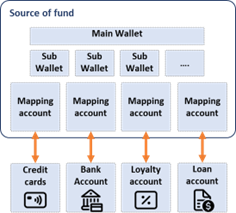
Main wallet

A perfect super-app requires a flawless payment platform with multi-wallet functionality to cater to all potential use cases. The internal wallet system should make use of main and sub-wallets concept.

The main wallet should not have any usage restrictions, apart from adhering to AML and fraud controls. Customers should have the freedom to deposit, withdraw, transfer, or pay for orders from their main wallet as long as they are performing legitimate transactions.

Sub wallet

On the other hand, a sub-wallet is similar to a main wallet but may have additional restrictions. For instance,

  • Loyalty wallet: a loyalty sub-wallet could be utilized to receive gift or loyalty balances that are rewarded upon certain usage or activity. The usage of loyalty balances should have some restrictions to control the financial impact. Typically, loyalty balances should not be transferred or withdrawn and may only be used to purchase pre-defined products with good margins or for internal products with lower production or shipping costs.
  • Outsourced wallet:  another form of a sub-wallet is an outsourced wallet, which is operated, refilled and controlled by a third-party. For example, this might be a payroll wallet or a government aid or support fund wallet, where all use cases are subject to a custom pricing or fee model based on a bilateral agreement with the third party.
  • Exchange wallet: another type of sub-wallet is an exchange wallet, which can be used to store foreign currency balances and allow only certain access to this wallet balance or provide exchange services within the same ecosystem. This feature can provide an additional benefit for countries with high tourist volumes.
  • Additional examples: Sub-wallets can be utilized in unlimited scenarios, and their potential usage cannot be limited or listed. Other examples of sub-wallet use cases include:
    • Billing sub-wallets, which are limited to paying bills and utility payments.
    • Promotion wallets, which store gift credits.
    • Internal benefit wallets, which are funded by a business entity and can only be used at pre-defined merchants.

In summary, sub-wallets provide a flexible and customizable solution for various payment needs and can be tailored to suit specific use cases, making them an integral part of a perfect payment platform for a super-app.

Mapping account

In addition to the financial benefits of having an internal wallet within the super-app itself, the ecosystem should extend to other possible accounts that customers may have, including but not limited to:

  • Bank accounts: any current or savings bank account with direct bank integration can support transferring existing funds from the bank account to our super-app wallets in a digital refill request. Moreover, the system should support a direct debit request towards a linked bank account against an online purchase or payment request.
  • Card accounts: with a load from card function or online card processing form, the system will enable customers to pay for their orders via card account.
  • Loan accounts: in the form of a loan, BNPL, or any digital finance account, the integration should be supported in the same way as a card or bank account. Upon paying for an order, the system will send a limit consumption request to the loan provider, and once a successful response is received, the order will complete successfully, and the fulfillment process will take place directly.
  • Loyalty: or external point system integration
  • Additionally, the ecosystem is flexible enough to onboard any other possible liability account, such as a loyalty or external point system integration. The system should avail the ability to use the integrated account in refill activity by loading or transferring credits from the mapping account to the system’s internal wallet. Or, it can use the account balance directly as a form of payment upon closing a transaction or paying for an order.

With this unique design and combined sub-wallet and mapping account features, the system can lock the refill values from being withdrawn or transferred to other accounts, which eliminates the credit liquidity risk for credit accounts.

02-Ecosystem

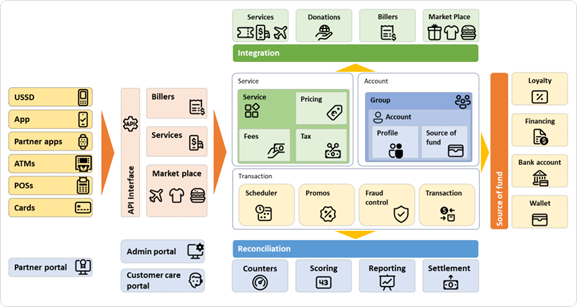
In this book, we aim to present our vision for the new super-app era. We believe that the future of super-apps lies in creating a complete ecosystem that leverages the power of AI and new analysis tools to seamlessly link all integrated services. This ecosystem will enable the delivery of a rich and enhanced end-user experience, with minimal effort and cost. Our vision for a super-app ecosystem could be summarized as below,

  • The ecosystem will be powered by AI and machine learning. These technologies will be used to personalize the user experience, to recommend relevant services, and to provide real-time insights.
  • The ecosystem will be open and interoperable. This means that it will be easy for businesses to add their services to the ecosystem, and for users to switch between different services.
  • The ecosystem will have the end-to-end product cycle from early suggestion or search response step to the order fulfillment and the after-sale support service if exist.
  • The ecosystem will have wide range of supported services per each product, with such multiple combinations each purchase request will be genuinely processed according to the user preferences.

Moreover, this ecosystem will offer a range of benefits for businesses, including increased customer engagement, cost savings, and access to valuable user data insights. The super-app ecosystem will allow businesses to offer a wide range of services and functionalities through a single platform, enabling them to reach a larger audience and differentiate themselves from competitors.

As illustrated above, the super-app ecosystem represents a combined components and modules that acts together to serve its connected users. In upcoming chapters, we aim to explore each component and try to understand its rule in the ecosystem design and why we thought of this component to be part of our visionary ecosystem design.

01-Super App

As a concept super-app was originated in Asia, where tech companies saw an opportunity to integrate multiple services and functionalities into a single mobile application. The was such services were integrated delivered a smooth and rich end user experience where users were able to run big portion of their daily routines through these super-apps.

The super-app concept was first introduced by WeChat, a messaging app developed by Tencent, which has since evolved into a platform that offers a wide range of services, including messaging, social networking, e-commerce, mobile payments, transportation, food delivery, and more. Since then, other companies, such as Grab, Gojek, and Paytm, have also developed super-apps that have become an integral part of daily life for millions of users in Asia.

The success of the super-app can be attributed to its convenience, efficiency, and cost savings for users, as well as its ability to provide businesses with a platform to reach a larger audience and offer a wider range of services. The super-app has transformed the way people interact with services and businesses on their mobile devices and is a testament to the power of innovation and integration in the tech industry.

Examples of super-apps:

The Asian market developed some good super-app examples, some of which include,

  1. WeChat: WeChat is a super-app developed by Tencent in China that allows users to communicate with friends, make payments, book transportation, order food, shop online, and play games.
  2. Grab: Grab is a super-app based in Southeast Asia that offers ride-hailing, food delivery, e-wallet, and financial services.
  3. Gojek: Gojek is a super-app from Indonesia that provides ride-hailing, food delivery, courier, and other on-demand services. It also offers a digital wallet for payments and financial services.
  4. Paytm: Paytm is an Indian super-app that offers digital wallet services, bill payments, mobile recharges, ticket booking, and online shopping.
  5. Alipay: Alipay is a Chinese super-app developed by Ant Group that offers mobile payments, financial services, insurance, and wealth management.
  6. LINE: LINE is a messaging app from Japan that has expanded into a super-app by offering services such as mobile payments, food delivery, e-commerce, and entertainment.

Business model,

The business model of a super-app typically revolves around offering a wide range of services and functionalities to users, while monetizing through various revenue streams. Here are some common revenue streams for super-apps:

  1. Commission-based: Super-apps charge businesses and service providers a commission per transactions made through their platform. For example, a food delivery service offered through a super-app may charge restaurants a commission on each order placed through the app.
  2. Subscription-based: Super-apps may offer premium services or features to users for a subscription fee. For example, a ride-hailing or car-parking service offered through a super-app may offer a premium membership that provides users with discounted fares and other perks.
  3. Advertising-base: Super-apps may sell advertising space to businesses that want to reach their user base. For example, a super-app may display ads from local businesses to users based on their location, preferences or their activities on the app.
  4. Data monetization: Super-apps generate a wealth of data on user behavior, preferences, and trends, which can be valuable to businesses. Super-apps reuse such data to offer new services or products suggested based on the user activities.
  5. Transaction-based: Super-apps may charge users a fee for certain transactions, such as money transfers or bill payments.

Overall, the business model of a super-app is focused on offering a comprehensive mobile experience to users and monetizing through various revenue streams. The key to success for a super-app is to offer high-quality services that users find valuable and convenient, while also providing businesses with a platform to reach a large and engaged audience.